Sunday, November 9, 2014

James Joyce Biography


James Joyce (1882-1941)

v     James Joyce is one of the most famous writers of the modernist avant-garde.

v     His most famous works are the novels Ulysses, Finnegan's Wake, and A Portrait of the Artist as a Young Man.

v      He also wrote Dubliners, a collection of short stories, as well as three books of poetry, and one play.

v     James Joyce was very musical, with an award winning voice, and also played the guitar and piano. Music was a very strong influence in his writing.

v     The famous Swiss psychiatrist Carl Jung, after reading Ulysses, concluded that James Joyce, like his daughter Lucia, was schizophrenic, "She and her father are like two people heading to the bottom of a river, except that Joyce was diving and Lucia was sinking."

Personal Life:

James Augustine Aloysius Joyce was born in Dublin, Ireland, to a middle class home. He was the eldest of twelve children, two dying of typhoid. His father worked, but was an alcoholic, a vice which James inherited. James had lifelong difficulty with his eyes, requiring dozens of operations. He also suffered from fear of dogs, after being attacked at the age of five, and fear of thunder, which an aunt explained was God's anger. Despite having a chaotic family life, he was a brilliant student, winning various awards.

Joyce went to university to study English lit, French, and Italian. He began publishing critical revues, for example to the Norwegian playwright Henrik Ibsen. In 1902, Joyce went to Paris to study medicine, but found it too difficult, and returned to Ireland when his mother was diagnosed with cancer.

In 1904, James left Ireland for good, living in Trieste with his life partner Nora Barnacle. Trieste is now in Italy, but at his time was part of the Austro-Hungarian empire. He made a living teaching English. He also persuaded several of his brothers and sisters to leave Dublin, and come live with him. Joyce refused invitations to return to Dublin, even from the famous Irish poet William Butler Yeats.

Although he rarely returned to Dublin, his stories all take place there, and his characters closely resemble his family, friends, and his enemies from his youth in Dublin. Mentally, he could never leave the city, saying:

"For myself, I always write about Dublin, because if I can get to the heart of Dublin I can get to the heart of all the cities of the world. In the particular is contained the universal."

In 1915, as World War I started, Joyce was helped by his wealthy students to get a travel passport so he and his family could flee to Zurich, Switzerland. He met several other famous writers and artists, including the poet Ezra Pound, and Harriet Shaw Weaver, a wealthy feminist who became James's patron. She gave him enough money to quit teaching and write full time for the rest of his life.

After the war, James tried living back in Trieste, but found the city had changed, and his brother Stanislaus was angry at him, having spent most of the war in a prison camp. So James went to Paris on a one week holiday that lasted over twenty years.

James Joyce fled from Paris to Zurich during WW II, to avoid the Nazis. He died there in hospital from an ulcer (vred). His body was buried in Zurich, and never moved to Ireland, despite Nora's offer. The Irish government refused to grant it.

James came from a Catholic family, but rejected Catholicism at a young age. He later wrote,
 
"My mind rejects the whole present social order and Christianity—home, the recognised virtues, classes of life, and religious doctrines. [...] Six years ago I left the Catholic church, hating it most fervently. I found it impossible for me to remain in it on account of the impulses of my nature. I made secret war upon it when I was a student and declined to accept the positions it offered me. By doing this I made myself a beggar but I retained my pride. Now I make open war upon it by what I write and say and do."

James displayed his lack of faith in extreme ways, refusing to kneel and pray at his mother's bedside as she lay dying. He also refused a Catholic service at his own funeral. Despite all this, he still regularly attended mass (omša) all his life.

Tuesday, October 28, 2014

Introduction to Egyptian Mythology


Ø      Egyptians wrote their history and mythology using hieroglyphics, a language of pictograms that we've learned to read because of the Rosetta Stone, a stele granting king Ptolemy V the status of a god.

Ø      The Rosetta Stone was written in 196 BC in Memphis, Egypt. In Medieval times, the temple was ruined, and the stone was used in the building of Fort Julien in the town of Rosetta, Egypt. It was discovered in 1799 and translated by Jean-François Champollion.

Ø      Egyptian mythology is confusing for several reasons. Egyptians were polytheistic, meaning they believed in many gods. And, some gods have more than one name.

Egypt's ancient towns and temples

Ø      Second, Egypt had different towns and cities, each with its own patron gods and myths. Joining them all together was hard, and had a lot to do with politics - the most important cities wanted to have the most important gods.

Ø      Sometimes, they'd take different gods, like Ra, Ptah, and Amun, and join them together. And, they had different wives, so how does that work? Another example, when Osiris died, he became god of the underworld. But there was already a god of the underworld named Ptah, so they joined into one god.

Ø      And then, people came from other lands, like Mesopotamia, Canaan, Nubia, and Greece, and brought their gods with them. So, Egyptians had to add them in somehow.

Ø      Finally, the Egyptian pantheon is confusing because there's no agreement on which gods were parents to which children. The texts don't agree with each other. So, making a family tree is very hard. Basically, instead of organizing this whole mess, ancient Egyptian priests all shrugged their shoulders (mykali plecami) and said, "Let's have lunch."

Ø      Another strange fact is that Egyptian gods didn't always need parents. Some of them simply made themselves, and one god, Horus, actually gave birth to himself over and over.

Ø      The most important belief in Egyptian Mythology was in maat, which means order and balance. Egyptians believed they had to maintain order, because all around them was the chaos of the desert and seas. Foreign armies came from these lands of chaos and were evil. The pharoah's job was to protect maat.
 
Ø      Egyptians also believed that a person's soul contained five parts:

  Ren (your name)
            Ba (your personality)
            Ka (your lifeforce/spirit)
            Shent (your shadow)
            Ib (your heart)

Ø      An important symbol in Egyptian mythology is the ankh, representing eternal life.

an ankh

Ø      Oh yeah, there was one pharaoh named Akhenaten (1350-1335 BC) who didn't like polytheism, so he changed the official religion, and made people worship a sun god named Aten. This new religion was monotheistic. As soon as Akhenaten died, his son reinstated (obnovil) all the old gods, and people tried to forget Akhenaten ever existed.

Bust of Akhenaten, 1353–1336 BC
 

Virginia Woolf Biography

Virginia Woolf (1882-1941)

v     Virginia Woolf was one of the most famous modernist writers, and was also an important member of the Bloomsbury Group of intellectuals.

v     Her most famous novels are Mrs. Dalloway, To the Lighthouse, and Orlando. Each of these stories focus on a kind of personal crisis which characters think about, while doing mundane (boring) things, in the midst of family problems and life during war time.

v     In 1938 she wrote Three Guineas, an essay that suggests fighting fascism with feminism, giving women more equality, thereby changing society as a whole. The idea is, Virginia asked, How can there be an end to fascism in the world, when there is fascism in every home?

v     In 1941 she wrote her last work Between the Acts, a novel written in verse. It's about an amateur play produced in an English village, representing a parody of English history and literature, from Shakespeare to the present.

v     She's also famous for her essay A Room of One's Own, in which she said "A woman must have money and a room of her own if she is to write fiction."

v     Virginia Woolf is considered a modernist because she wrote using stream of consciousness, as well as focusing on the emotional motives of her characters. Stream of consciousness is when you enter the mind of a character and see what he or she is thinking, often randomly going from one idea to another.

"Examine for a moment an ordinary mind on an ordinary day. The mind receives myriad impressions - trivial, fantastic, evanescent, or engraved with the sharpness of steel . . . Is it not the task of the novelist to convey this varying, this unknown and uncircumscribed spirit?"

Personal Life:

Virginia Woolf, by her sister Vanessa Bell
 
Virginia Woolf came from a large family in Kensington, London. Her father was a historian, and his mother was a model for famous Pre-Raphaelite painters, like Edward Burne-Jones. She was educated by her parents. Her brothers went to a formal school, which Virginia resented, but the family had a large library, so she read a lot, and her house also received visits from famous writers like Henry James. Every summer her family visited St. Ives in Cornwall, which was a great influence on her writing.

Virginia began writing at eighteen, for the Times Literary Supplement. She married Leonard Woolf in 1912. Although happy with her husband, Virginia also experimented a bit with a lady named Vita Sackville-West, whom Virginia portrayed in her novel Orlando.

Virginia suffered from bipolar disorder, a psychological illness in which your mood changes quickly and suddenly, from happy to sad, and calm to angry. She suffered a series of nervous breakdowns following the deaths of family members - her mother when she was thirteen, her sister Stella when she was fifteen, and then her father when she was twenty-two. Adding to the depression, she was sexually abused by her step brothers. She was put in psychiatric care numerous times. Life became unbearable for her during World War II, when London was Blitzed. She wrote a biography that no one liked, about her friend, the artist Roger Fry. So, she committed suicide, filling her coat with stones and walking into the River Ouse, where she drowned, age 59. Her last note reads,

"Dearest, I feel certain that I am going mad again. I feel we can't go through another of those terrible times. And I shan't recover this time. I begin to hear voices, and I can't concentrate. So I am doing what seems the best thing to do. You have given me the greatest possible happiness. You have been in every way all that anyone could be. I don't think two people could have been happier till this terrible disease came. I can't fight any longer. I know that I am spoiling your life, that without me you could work. And you will I know. You see I can't even write this properly. I can't read. What I want to say is I owe all the happiness of my life to you. You have been entirely patient with me and incredibly good. I want to say that—everybody knows it. If anybody could have saved me it would have been you. Everything has gone from me but the certainty of your goodness. I can't go on spoiling your life any longer. I don't think two people could have been happier than we have been. V"

Virginia Woolf, by Roger Fry

Saturday, October 11, 2014

Adventures of Huckleberry Finn

by Mark Twain (1835-1910)

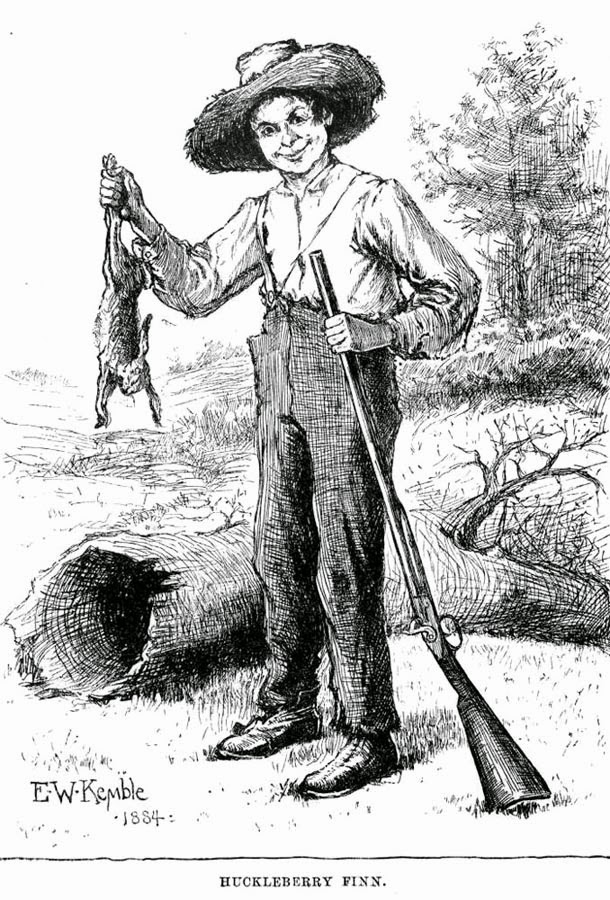
Huck Finn by E. W. Kemble

v     This book, written in 1884, is the sequel to the Adventures of Tom Sawyer.

v     Although it was written after the Civil War in 1860, the events take place before the war happened.

v     This book is far more controversial than The Adventures of Tom Sawyer, because it deals with the subjects of slavery and racism. This book is a satire of American society.

v     This book makes use of vernacular English - the characters speak in strong dialect. Many critics have complained about this, as well as the use of racial stereotypes and slurs, for example, the 'N' word.

v     One example of the vernacular is the first sentence which Twain changed repeatedly: He first wrote, "You will not know about me", which he changed to, "You do not know about me", before settling on the final version, "You don't know about me, without you have read a book by the name of 'The Adventures of Tom Sawyer'; but that ain't no matter."

v     Twain mocked his critics. When the Concord, MA, public library banned his book, he said, " Apparently, the Concord library has condemned Huck as 'trash and only suitable for the slums.' This will sell us another twenty-five thousand copies for sure!"

The Plot:

v     The story begins with Tom helping Huck sneak out at night, from the home of Widow Douglas, and her strict sister Miss Watson, whom Huck doesn't like. Miss Watson owns a slave named Jim, and the boys have to be quiet so he doesn't hear them.

v     The boys go out to play, but Huck's father finds them, and takes Huckleberry back to his cabin in the woods.

v     Huckleberry fakes his own death while his father is out, and sneaks off for Jackson's Island, where he and Tom had played pirates in the last book.

v     There he finds Jim, who has also run away. Miss Watson had wanted to sell him to some brutal slave owners who live down river. Jim plans to escape to the north, to Cairo Illinois, a free state. There he can work to buy his family's freedom.

v     At first Huck feels bad for helping Jim, a runaway slave, but they become friends, and the older Jim becomes his protector.

Jim & Huck on the Raft, by Achille Sirouy

v     The Mississippi River floods, so Huck & Jim get on a raft for safety. The see an old house floating down along the river and check it for food. Jim finds a dead body, and won't tell Huck who it is.

v     Huck returns to town, dressed as a girl, to learn what the town thinks happened to him. Everyone thinks he was killed, either by his dad, or Jim, and the promise of a reward has prompted a manhunt. A posse plans to check Jackson's Island that night, so Huck & Jim pack up their raft and leave down the river.

v     After various adventures, Huck & Jim are separated, after their raft is hit by a steamboat, and Huck ends up in Kentucky. There, he is taken care of by a kind family called the Grangerfords. They are rich, and they have a boy named Buck who is Huck's age. They quickly become friends.

v     The Grangerfords are feuding with another family called the Shepherdsons, similar to the families in Romeo & Juliet. When Buck's older sister elopes with a young Shepherdson boy, the families fight, and all the male Grangerfords are killed, including Buck. Huck goes to find Jim, who has fixed their raft. Jim thought Huck had died, and is shocked to see him.

Jim and the Ghost, by E. W. Kemble

v     Near the Arkansas border, Huck & Jim join two grifters (con artists) who pretend to be royalty from Europe. One claims to be the long lost son of the Duke of Bridgewater, while the older man pretends to be the son of Louis XVI of France. He calls himself the Lost Dauphin.

The Grifters, by Achille Sirouy

v     These grifters run a number of scams in different towns, using Huck & Jim in various ways. They sell tickets for a play, which only lasts a few minutes. Then they go to a funeral, where they claim to be long lost brothers of a dead man, to get his inheritance.

v     When Huck steals the money to give it back to the rightful family, the Duke and Dauphin sell Jim. Huck decides, "Alright, then, I'll go to hell!" and goes to find Jim and free him.

v     Jim is being held on Silas Phelp's Plantation. Silas was expecting a young nephew named Tom to visit, so Huck pretends to be him. Then, as luck would have it, their nephew is none other than Tom Sawyer, who finally arrives. Huck tells Tom everything, and Tom decides to help Jim too. Tom pretends to be his half-brother Sid.

v     Huck warns the town about the Duke & Dauphin, so when they come to town, they are tarred and feathered. This was a common punishment in these times:


v     Tom plans Jim's escape, but when they try it, Tom gets shot in the leg. Jim won't leave him, and takes him to a doctor, who helps Tom, but takes Jim back to the plantation.

v     Before Jim is punished, Tom's Aunt Polly comes to the farm. She gives the news that old Miss Watson is dead, and, in her will, she freed Jim! He was really free the whole time! And Tom knew too, but he thought escaping would be much more fun. And, it turns out the dead man in that floating house at the beginning, was actually Huck's father, so Huck is free too. Sally Phelps wants to adopt him, but Huck wants to run away to Indian territory.

Monday, September 29, 2014

The Adventures of Tom Sawyer


v     This is a coming of age story about a boy who lives in a fictional town, St. Petersburg, Missouri, along the Mississippi River. It's a light-hearted, adventurous comedy. St. Petersburg was based on Twain's home town of Hannibal:

Hannibal, Missouri, from Google Maps
 
v     It's also the first in a series of stories about the life of Tom Sawyer, including Tom Sawyer, Abroad, and Tom Sawyer, Detective.
v     Tom Sawyer is a lovable rascal. He's lazy, arrogant, immature, manipulative, and a liar, but he has a good heart. Throughout the story, he gets himself and his friends into and out of trouble.
v     Tom's an orphan, so he lives with his kind-hearted aunt Polly, and his half-brother Sid, who is well behaved, but dislikes Tom. Sid is a tattle-tale, he tells aunt Polly every bad thing that Tom does.
v     This is a coming of age story for two reasons. First, because Tom discovers girls, and falls in love with Becky Thatcher (daughter of Judge Thatcher). Second, because Tom witnesses a murder and sees the darker side of life.
v     Tom does lots of bad things. He skips school to go swimming. He steals jam from aunt Polly. He gets into fights. And, when his aunt makes him paint a fence on Saturday as punishment, he tricks a bunch of other children to do it for him, convincing them it's so much fun that they pay him to get to paint it.

Painting the Fence, by Norman Rockwell
 
v     He then uses all the gifts they gave him to get enough tickets at Sunday school to earn a free bible - well almost. As a judge was just about to give it, he asked Tom to name the first two apostles, and Tom answered, "David and Goliath."

Tom's Final Exam, by Luis Dominguez
 
v     Tom has two best friends. One, Joe Harper, is much like him. The second, Huckleberry (Huck) Finn, is the son of the town drunk.


Tom thinks Huck is lucky because he can do whatever he wants - play, fish, swim, curse, smoke, etc., and he never has to go to church or school. He doesn't have to wear clean clothes. But then, Huck has an abusive father he has to hide from, and all the town shuns him, even though Huck turns out to be a hero.
v     To make this story exciting, there is a villain named Injun Joe. First, Injun Joe kills the town doctor, and blames it on someone else. Tom & Huck witness the murder.

Witnessing a Murder, by Luis Dominguez
 
v     Joe killed the doctor in the town cemetery during an argument over extra payment, while digging up corpses for medical experiments. He blamed another drunk named Muff Potter.
v     Feeling guilty, but too scared to name Joe as the killer, Tom, Joe, and Huck run away by raft to Jackson's Island on the Mississippi, to play pirates.

Boys on the Raft, by Luis Dominguez

Everyone in town assumes the boys have died, so they return home in time for their funerals, and shock the town.
v     Tom then testifies against Joe, who escapes, jumping out the courtroom window.
v     Then the story revolves around a haunted house and a cave, where Injun Joe buries a chest full of gold, and Tom Sawyer finds it.
v     At the end of the story, the cave is sealed with Joe inside. He dies of starvation, and Tom & Huck go back to get the gold, which they leave to Judge Thatcher to hold for them until they grow up.
v     Huck Finn saved an elderly widow named Mrs. Douglas, whom Injun Joe wanted to rob and kill. Huck had been brave enough to follow Joe for days, learning where the treasure was, and he heard Joe's plan. So, Huck went to her neighbor, Mr. Jones, who then saved her life, scaring off Joe. At the end of the story, Widow Douglas takes in Huck as her own child.

Wednesday, August 20, 2014

Mark Twain Biography


Mark Twain (1835-1910)

v     He is one of America's most famous writers and humorists. William Faulkner called him The Father of American Literature.
 
v     His real name was Samuel Clemens. Mark Twain was his pen name. "Mark twain!" is what riverboat sailors would shout, when the water was deep enough for the boat to pass safely.
 

v     Other pen names he used early on were Grumbler, Rumbler, and Thomas Jefferson Snodgrass.
 
v     He's most famous for his novels The Adventures of Tom Sawyer, and its sequel Adventures of Huckleberry Finn.
 
v     His first successful one was "The Celebrated Jumping Frog of Calaveras County." He became known for his newspaper stories as The Humorist of the Pacific Slope.
 
v     In 1867 he visited Europe and the Holy Land. He wrote about everything he saw in his book The Innocents Abroad.
 
v     Moving to Connecticut, Twain became friends with abolitionists and feminists like Harriet Beecher Stowe, Frederick Douglass, and the socialist, William Howells.
 
v     He also became a close friend of Nikola Tesla, spending time in his laboratory.
 
v     Twain was a very popular public speaker, doing what would later be known as stand up comedy. In Vienna, he gave a speech in German, titled "The Horrors of the German Language".
 
v     He also wrote The Prince And The Pauper, and A Connecticut Yankee in King Arthur's Court.

v     He received an honorary degree from Oxford University and two from Yale University.

Personal Life:

Mark Twain was born soon after the passing of Halley's Comet, and died the day after it returned, just as he'd predicted. He said, "I came in with Halley's Comet in 1835. It is coming again next year, and I expect to go out with it. It will be the greatest disappointment of my life if I don't go out with Halley's Comet. The Almighty has said, no doubt: 'Now here are these two unaccountable freaks; they came in together, they must go out together.' "
He was the sixth of seven children, but only four survived to adulthood. His father was a judge, and died of pneumonia when Mark was eleven. As a teen he worked for a printer, and wrote articles for his older brother's newspaper, The Hannibal Journal. He travelled to NYC, Philadelphia, St. Louis, and Cincinnati, working as a printer. He also tried jobs as a riverboat pilot and a miner.
According to Twain, being a riverboat pilot was every child's dream. The pilot had to, "get up a warm personal acquaintanceship with every old snag and one-limbed cottonwood and every obscure wood pile that ornaments the banks of this river for twelve hundred miles; and more than that, must ... actually know where these things are in the dark..."
Mark convinced his younger brother, Henry, to work on a riverboat as well. When Henry's boat exploded, killing him, Mark never forgave himself. He even forsaw the event in a dream months before, starting his interest in parapsychology.
Changing careers to journalism, he began writing short stories. While travelling to the Holy Land, he met his future brother-in-law, who showed a photo of his sister, Olivia Langdon. "It was love at first sight." He courted the woman for years, and they married in 1870.

Famous Quotes:

"Books of the great geniuses are like wine. My books are like water. Everybody drinks water."

"Humor is mankind's greatest blessing."

"To succeed in life you need two things: ignorance and confidence."

"I have never let my schooling interfere with my education."

"The best way to cheer yourself up is to cheer somebody else up."

"Get your facts first. Then you can distort them as you please."

"The lack of money is the root of all evil."

"The main difference between a cat and a lie is that a cat only has nine lives."

"We have the best government that money can buy."

"Man is the only animal that blushes - or needs to."

"Clothes make the man. Naked people have little or no influence on society."

"It's no wonder that truth is stranger than fiction. Fiction has to make sense."

"Whenever you find yourself on the side of the majority, it is tie to pause and reflect."

"Faith is believing what you know ain't so."

"If Christ were here now there is one thing he would not be—a Christian."


Monday, May 12, 2014

Grapes of Wrath Excerpt 3 - Migrant Workers

THE MOVING, QUESTING people were migrants now. Those families who had lived on a little piece of land, who had lived and died on forty acres, had eaten or starved on the produce of forty acres, had now the whole West to rove in. And they scampered about, looking for work; and the highways were streams of people, and the ditch banks were lines of people. Behind them more were coming. The great highways streamed with moving people. There in the Middle—and Southwest had lived a simple agrarian folk who had not changed with industry, who had not farmed with machines or known the power and danger of machines in private hands. They had not grown up in the paradoxes of industry. Their senses were still sharp to the ridiculousness of the industrial life.
And then suddenly the machines pushed them out and they swarmed on the highways. The movement changed them; the highways, the camps along the road, the fear of hunger and the hunger itself, changed them. The children without dinner changed them, the endless moving changed them. They were migrants. And the hostility changed them, welded them, united them—hostility that made the little towns group and arm as though to repel an invader, squads with pick handles, clerks and storekeepers with shotguns, guarding the world against their own people.
In the West there was panic when the migrants multiplied on the highways. Men of property were terrified for their property. Men who had never been hungry saw the eyes of the hungry. Men who had never wanted anything very much saw the flare of want in the eyes of the migrants. And the men of the towns and of the soft suburban country gathered to defend themselves; and they reassured themselves that they were good and the invaders bad, as a man must do before he fights. They said, These goddamned Okies are dirty and ignorant. They're degenerate, sexual maniacs. Those goddamned Okies are thieves. They'll steal anything. They've got no sense of property rights.
And the latter was true, for how can a man without property know the ache of ownership? And the defending people said, They bring disease, they're filthy. We can't have them in the schools. They're strangers. How'd you like to have your sister go out with one of 'em?
The local people whipped themselves into a mold of cruelty. Then they formed units, squads, and armed them—armed them with clubs, with gas, with guns. We own the country. We can't let these Okies get out of hand. And the men who were armed did not own the land, but they thought they did. And the clerks who drilled at night owned nothing, and the little storekeepers possessed only a drawerful of debts. But even a debt is something, even a job is something. The clerk thought, I get fifteen dollars a week. S'pose a goddamn Okie would work for twelve? And the little storekeeper thought, How could I compete with a debtless man?
And the migrants streamed in on the highways and their hunger was in their eyes, and their need was in their eyes. They had no argument, no system, nothing but their numbers and their needs. When there was work for a man, ten men fought for it—fought with a low wage. If that fella'll work for thirty cents, I'll work for twenty-five.
If he'll take twenty-five, I'll do it for twenty.
No, me, I'm hungry. I'll work for fifteen. I'll work for food. The kids. You ought to see them. Little boils, like, comin' out, an' they can't run aroun'. Give 'em some windfall fruit, an' they bloated up. Me, I'll work for a little piece of meat.
And this was good, for wages went down and prices stayed up. The great owners were glad and they sent out more handbills to bring more people in. And wages went down and prices stayed up. And pretty soon now we'll have serfs again.
And now the great owners and the companies invented a new method. A great owner bought a cannery. And when the peaches and the pears were ripe he cut the price of fruit below the cost of raising it. And as cannery owner he paid himself a low price for the fruit and kept the price of canned goods up and took his profit. And the little farmers who owned no canneries lost their farms, and they were taken by the great owners, the banks, and the companies who also owned the canneries. As time went on, there were fewer farms. The little farmers moved into town for a while and exhausted their credit, exhausted their friends, their relatives. And then they too went on the highways. And the roads were crowded with men ravenous for work, murderous for work.
And the companies, the banks worked at their own doom and they did not know it. The fields were fruitful, and starving men moved on the roads. The granaries were full and the children of the poor grew up rachitic, and the pustules of pellagra swelled on their sides. The great companies did not know that the line between hunger and anger is a thin line. And money that might have gone to wages went for gas, for guns, for agents and spies, for blacklists, for drilling. On the highways the people moved like ants and searched for work, for food. And the anger began to ferment.